How to roast vegetables together without uneven results
· Editorial team newsfromhouston24.com
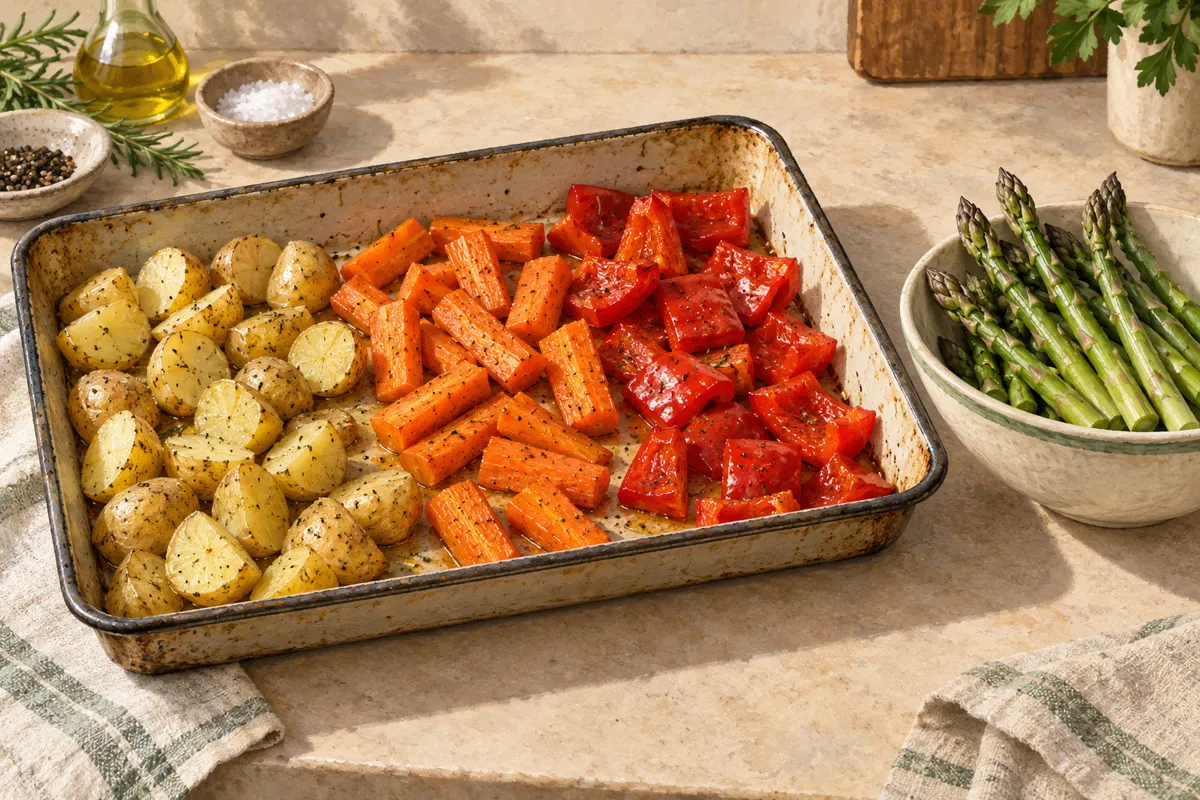
To roast different vegetables together evenly, cut dense vegetables into smaller pieces, keep similar ingredients grouped on the tray, and add quick-cooking vegetables later. Check each group for tenderness as it cooks, and remove anything that finishes early. A shared tray does not require every vegetable to enter or leave the oven at the same time.
Choose vegetables with a workable cooking order
Start by sorting your vegetables before you season them. Potatoes and carrots need a different approach from zucchini or asparagus. The goal is to give firm pieces enough time to soften while keeping tender ingredients from becoming limp.
- Start first: potatoes, carrots, and other dense roots.
- Check in the middle: cauliflower, pepper pieces, and onion wedges.
- Add later or check early: zucchini, asparagus, and small tomatoes.
These groups are a planning guide, not a fixed timetable. Thickness matters, especially with asparagus and cauliflower stems. The supplied CANAL+ KUCHNIA recipe illustrates the timing difference: at the same oven temperature, it gives asparagus 10 minutes and zucchini, tomatoes, and peppers 20 minutes.
Match the cuts to the vegetables
Make pieces consistent within each vegetable type, but do not cut every ingredient to identical dimensions. A thick carrot chunk and a similarly sized zucchini chunk will not necessarily finish together. Cut the carrot smaller, or give it a head start.
- Cut potatoes into small, evenly sized chunks rather than mixing large wedges with tiny cubes.
- Slice carrots into pieces of similar thickness; split a wide end lengthwise when needed.
- Divide cauliflower into comparable florets and trim thick stems.
- Keep zucchini in substantial pieces so it holds its shape.
- Leave a little root end attached to onion wedges to help the layers stay together.
Look for outliers before cooking. One oversized potato piece can remain firm after its neighbors are ready. Correcting the cut now is easier than trying to compensate once everything is hot.
Give the tray enough room
Dry the washed vegetables, then toss them with oil and seasoning until their surfaces are lightly coated. Spread them in a single layer with some space between pieces. Crowding traps moisture around the vegetables and makes browning harder.
Keep each vegetable in its own loose area rather than thoroughly mixing the tray. This makes it easier to turn the roots, add asparagus, or lift out finished zucchini. Reserve space for later additions; if everything will only fit in a heap, use a second tray.
Oil and herbs feature in all four supplied recipes, but their oven settings and cooking times vary substantially. Follow one coherent method and check the food instead of combining a temperature from one recipe with a time from another.
Add tender vegetables in stages
Editorial proposal: for a tray of potatoes, carrots, peppers, and asparagus, use the sequence below. A preheated oven at 425°F is a practical starting setting for this proposed method. Treat the vegetables’ texture as the deciding factor rather than expecting one exact finishing time.
- Prepare and season each vegetable group separately. Spread the small potato chunks and carrot pieces on the tray first.
- Roast until the roots begin to soften at the edges, then turn them and add the pepper pieces in the reserved space.
- When a fork begins to enter the roots but their centers still resist, add the asparagus. Thicker spears may need an earlier start.
- Check each group regularly. Transfer finished vegetables to a serving dish and let the remaining pieces continue cooking.
Check tenderness and correct uneven cooking
Test one of the largest pieces from each group. Potatoes and carrots should yield readily to a fork; peppers should be softened, and asparagus should reach your preferred tenderness. Brown edges alone do not tell you whether a dense center is cooked.
- If one group finishes early, remove it while the rest cooks.
- If one side browns faster, rotate the tray and turn the affected pieces.
- If the vegetables sit in pooled liquid, spread them farther apart or divide them between trays.
- If roots repeatedly lag behind, cut them smaller or start them earlier next time.